What it is
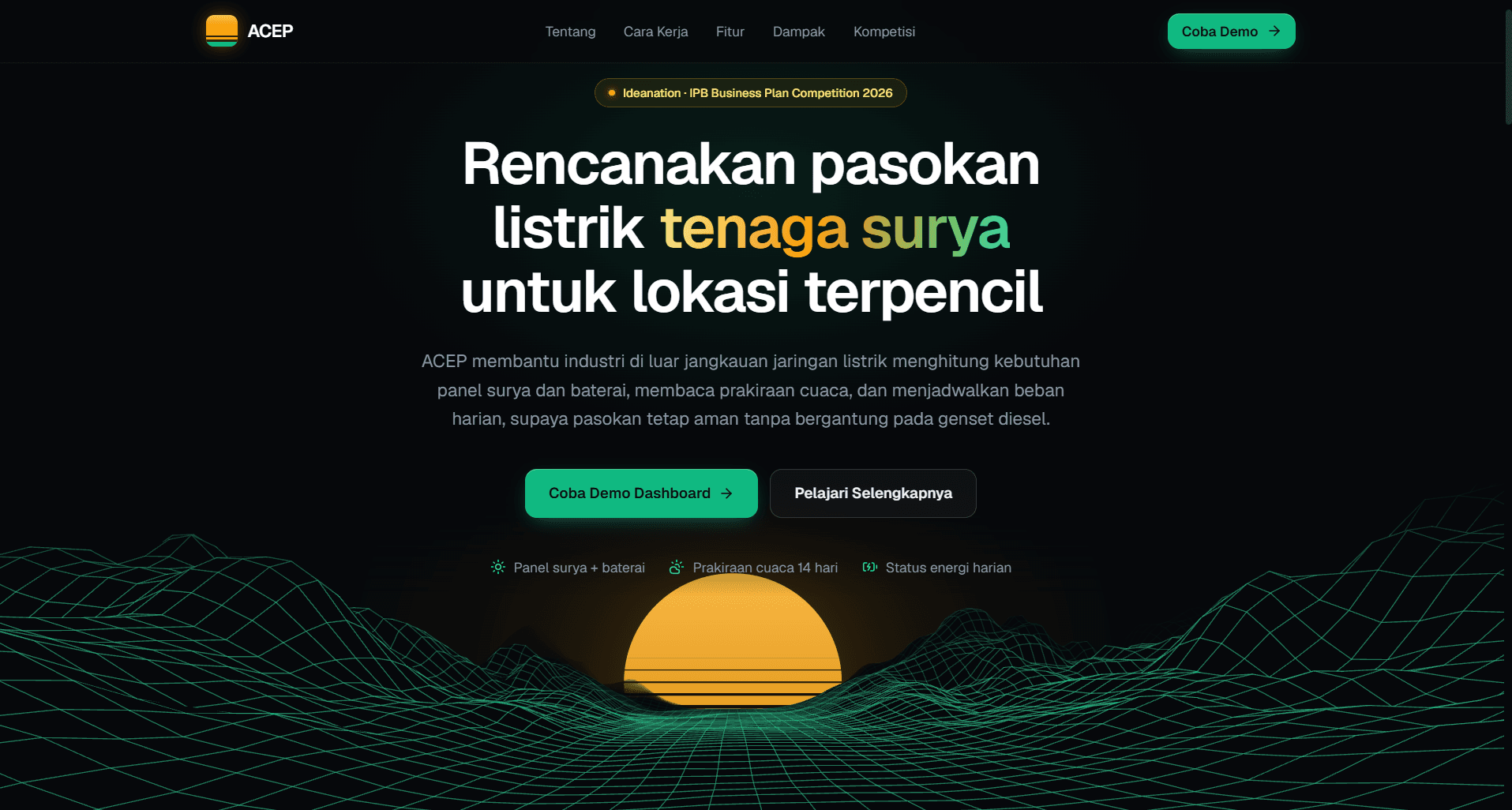
ACEP (Advanced Clean Energy Planning) is a web platform for running a remote site on solar power. An operator records the equipment that draws power, the solar generators and the battery bank; ACEP combines that with a 14-day weather forecast for the site and colours an energy calendar – green where the supply is safe, amber where it depends on the sun showing up, red where it will fall short. An AI assistant answers planning questions in Indonesian along the way.
The problem
Mines, plantations, fisheries and facilities on Indonesia's outer islands often sit beyond the reach of the PLN grid, so they run on diesel generators – expensive to ship in, loud, and carbon-heavy. Solar is the obvious alternative, but installing panels is not the hard part. The hard part is knowing whether the supply will hold on a cloudy week and through every night, and almost nobody on these sites has a tool to answer that.
Chapter 01
A business plan that needed a working product
ACEP started as an entry to Ideanation, the business plan track of the IPB Business Plan Competition. The thesis was a SaaS model for remote industries moving off diesel – and a business plan about planning software is only as convincing as the planner behind it.
ACEP is a two-person company, and as CTO the product side was mine: architecture, data model, the planning logic and the web app. Instead of mock-ups, the pitch was backed by a running prototype – accounts, a real database of equipment and storage, live forecasts and a dashboard a judge could click through. ACEP reached the final six.
“Installing panels is easy. Knowing the power will still be there on a cloudy Thursday night is the product.”
Chapter 02
One honest rule, applied one day at a time
The planner deliberately uses a rule an operator can check by hand. For each day: if the battery alone covers the scheduled load, the day is safe. If it only works once that day's solar generation is added, it is a warning – the plan depends on the weather. If even both together fall short, the day is marked insufficient.
What makes it useful is the carry-over. Whatever the battery holds at the end of one day, capped at its capacity, is what it starts the next with. A single overcast day rarely matters; three in a row is where a site goes dark, and the calendar shows that run of amber turning red before it happens.
Chapter 03
Weather turns a static plan into a forecast
Hourly weather codes from Open-Meteo are grouped into days and translated into an expected generation level, from clear skies down to storms. That is what moves the calendar from "your system is sized correctly on average" to "next Tuesday is the day to cut non-essential load".
An assistant connected through n8n sits on the dashboard for the questions a calendar cannot answer – what a status means, how to adjust a schedule – and every conversation is stored per user.
Key decisions
04A transparent threshold rule instead of an opaque model
Operators who have relied on diesel for years will not trust a black box with their power supply. Safe, warning and insufficient are defined by comparisons they can redo on paper: storage against load, then storage plus generation against load.
Trade-off · It ignores intra-day timing – a battery that is full at noon but empty at 3 a.m. still reads as one daily total.
Battery state carried across days
Energy shortfalls are cumulative. Simulating each day from the previous day's ending charge is what exposes the multi-day cloudy spells that actually cause outages.
Trade-off · A wrong assumption early in the window compounds through every day after it.
Open-Meteo for the 14-day forecast
Free, key-less and global, with hourly weather codes for any coordinate – which matters when the sites are remote islands rather than cities.
Trade-off · Weather codes are a coarse proxy for solar irradiance, so expected generation is banded rather than physically modelled.
Supabase for auth and data, n8n for the assistant
In a competition timeline, accounts, row-level data per user and a hosted Postgres come for free, and the AI assistant can be iterated in a workflow tool without redeploying the web app.
Trade-off · The assistant's behaviour lives outside the repository, so it is versioned separately from the code that calls it.
Results
- Top 6 finalist, Ideanation – IPB Business Plan Competition 2026.
- Working prototype live at acep-prototype.vercel.app, with a one-click demo account for judges.
- Equipment loads, solar generators and battery storage managed per user, backed by Supabase.
- Day-by-day energy calendar for the next 14 days, driven by live Open-Meteo forecasts.
- Built-in Indonesian-language AI assistant, connected through n8n, with stored chat history.
- The business plan projected up to 60% lower operating costs and up to 75% lower emissions for a site moving from diesel to planned solar.
Looking back
Building the prototype changed the pitch. Once judges could watch a cloudy week turn the calendar from green to red, the business case did not need to be argued – it was on the screen. The next step would be to replace weather-code bands with irradiance data and hourly simulation, so the planner can say not just which day is at risk, but which hour.